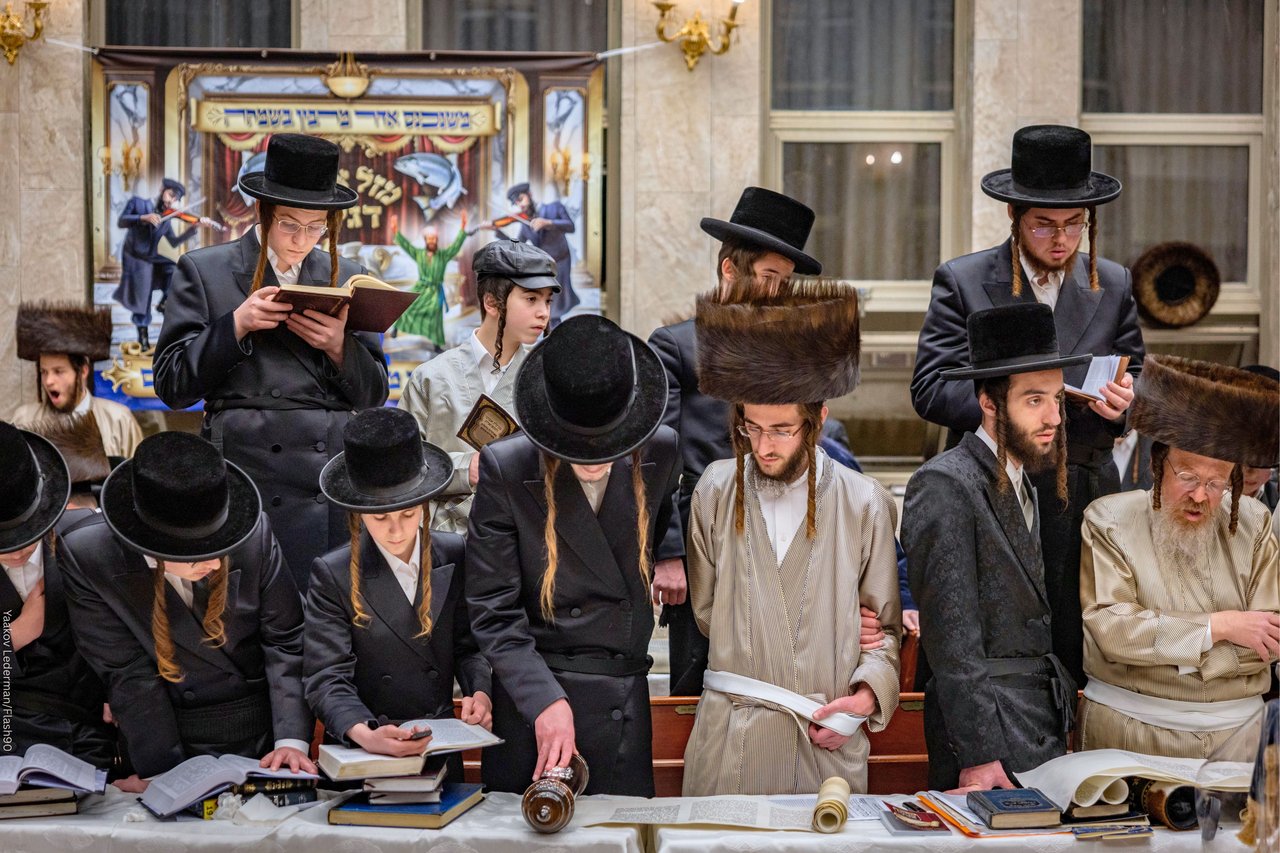
Why Israel? The Book.
Publishing
Israel doesn’t have to be complicated.
I mean, it is complex. But it is also simple. Because God doesn’t change. And He said a lot about Israel.
If we understand God’s character as a loving father, a longing groom and a committed husband, we can easily imagine how God views Israel.
Perhaps you have not experienced that kind of protection or faithfulness in your own life. Perhaps those closest to you did not demonstrate stability and safety. In that case, you may discover how beautiful these characteristics are when you read about God in the Bible. God embodied these roles to perfection with Israel. And He did this to show how He desires to do the same with you!
Israel is more than a headline. It is the stage for God’s unfolding love story with humankind. From Abraham’s covenant, to the plan of salvation, to the modern miracle of the Jewish people returning home, the question “Why Israel?” is not just theological.
It is deeply personal.
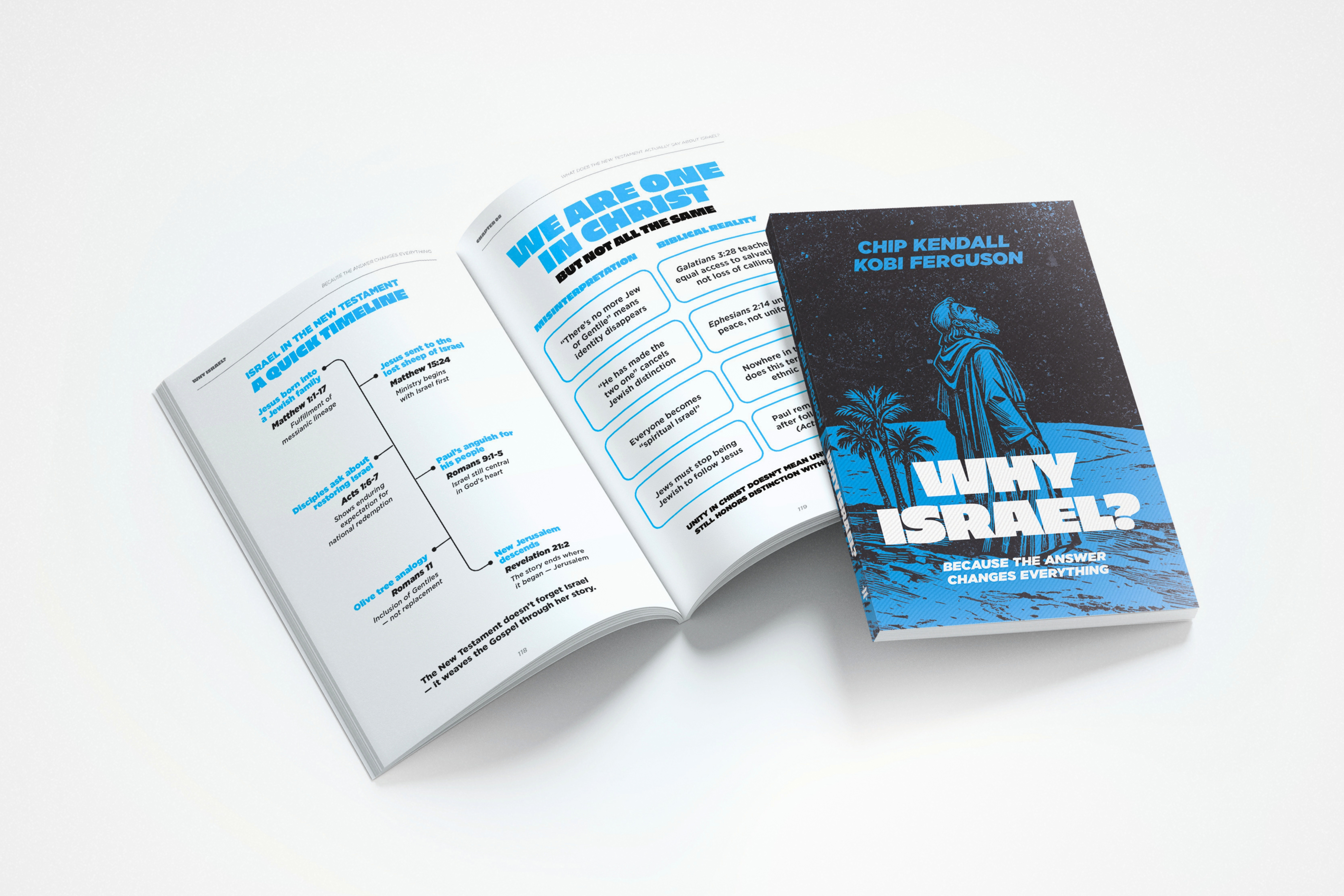
So, let’s start by introducing you to the people who wrote the book, “Why Israel?”
Once Upon A Time
Kobi and Chip wrote this book—and it’s brilliant! In fact, it’s not uncommon for people to buy a copy, go home, read it, and come back the same day to buy 10 more. Sometimes they place an order for everyone in their family or on their staff. It’s that good.
I could give technical reasons why people like it so much, because the layout is so reader-friendly. But, first let me explain why the message in the book is so clear.
Kobi and Chip are simultaneously insiders and outsiders. They both lived in Israel and abroad for significant periods of their life—and so they understand what it feels like to look from the inside out and the outside in.

Kobi
It was 28 years ago when Kobi (25 at the time) visited Israel for the first time. He had already met my parents. We knew we were headed for marriage and life in Israel. But he had never been, and it was important that he understood what he was getting into.
I like to say God made Israeli women beautiful, so someone would marry them. Call it a backhanded compliment or an eloquently wrapped insult. It’s funny, but it’s not a joke. I’ve seen many an international man fall head over heels for a local beauty and not fully realize what he’s getting into. Israeli women grow up amidst a complex blend of ancient patriarchal traditions and modern narratives of self-dependence and women’s rights. They are raised to cherish motherhood and family. Then at 18, they are handed boots, a uniform, and an M16, and thrown into boot camp somewhere in the desert. They can be both delicate and fierce, which makes them quite the brides.
Twenty-seven years later, Kobi has survived being a husband to an Israeli and together we’ve added five new humans to the Israeli population. Our youngest is 10, and our oldest, at 21, will complete her combat service in the Israeli Air Force this summer. Kobi’s up-close and personal experience with Israeli life, combined with his background in theological studies, makes him a perfect co-author for a book like “Why Israel?”
Kobi explains it best like this:
“Reading Romans 11 for the first time blew me away. Paul isn’t gentle—he’s direct. He tells Gentile believers not to get arrogant. ‘You’re grafted in,’ he says, ‘not replacing the tree, but becoming a part of it.’ That changed everything for me. The Church isn’t Plan B. It’s part of God’s original plan, together with and through Israel.
Some people think caring about Israel means turning your back on the Church. Not at all. It’s one story. One God. One unfolding plan. When the Church honors its Jewish roots, it becomes stronger. And when Israel sees the love of Yeshua through the global Church, we’ll begin to see their heart become vulnerable.
God doesn’t replace His people when they stumble—He redeems them. That’s the Gospel and Israel is living proof.”

Chip
Chip and I were both teenagers when he and his family lived in Jerusalem. I lived in Tel Aviv and would occasionally come up to his youth group because there wasn’t one in my area. We weren’t super close. Chip was a few years older—a very hyper, life-of-the-party kind of guy, and I was a wear-all-black-and-chill-in-the-corner kind of person. But looking back, I admired how he wholeheartedly poured his energies into chasing God. This was especially important because he always had a crowd of teens following him.
Chip eventually moved to the UK to build a family with a lovely British girl who won his heart. About 10 years ago, we began a conversation about how vulnerable young people were to worldly narratives because they did not regularly absorb Scripture on their own. This also explained why they did not understand the Biblical connection between Israel and their faith—and were frequently swayed against Israel.
Chip deeply wanted this to change—and so he joined Maoz and now advocates with us for a Biblical understanding of Israel around the world.
Despite being in his late 40s, he’s the same ball of energy he was at 17. You could say Chip never grew up. And maybe it’s good he didn’t, because he still has crowds of young people following him, and that’s exactly who we need to reach.
Chip explains a bit more:
“When I was 12, my family moved from the United States to Israel. It was a whirlwind—new smells, new pace, new culture, new language. But one of the strangest adjustments came in a place I thought would feel familiar: worship. Back in the States, I’d grown up singing all the classics: ‘Jesus, Lover of My Soul,’ ‘No Other Name,’ and ‘Holy and Anointed One.’ In Israel, the name ‘Jesus’ had been replaced with ‘Yeshua.’ Now, I knew that Yeshua was His Hebrew name. I got it—intellectually. But hearing it sung out loud felt… different. Almost like I was singing to someone else. My soul and my theology were bumping into each other—and it was disorienting.
That discomfort taught me something: when God invites us deeper into His story, it often touches something sacred—and that can feel strange at first. That’s exactly how many people feel when they first start asking questions about Israel. If you’re feeling stretched—that’s okay. Sometimes what feels strange is actually an invitation to go deeper. Israel matters—not because the people are perfect, but because God is faithful. He made promises and He keeps them. And He’s inviting us—Jew and Gentile—into the same redemption story. Not out of guilt. Not out of hype. But out of love.”
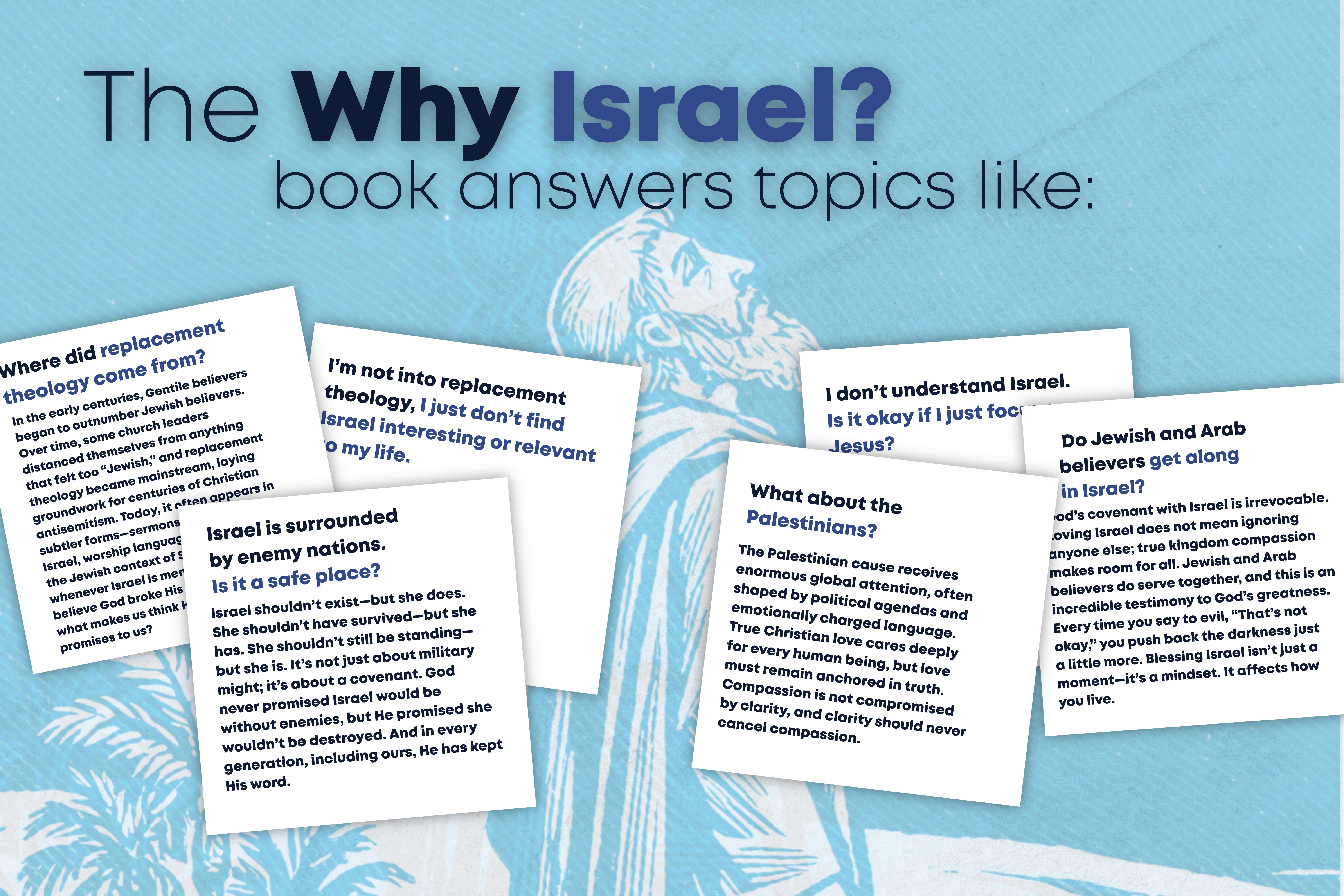
The Why Israel? book answers topics like:
• Where did replacement theology come from?
In the early centuries, Gentile believers began to outnumber Jewish believers. Over time, some church leaders distanced themselves from anything that felt too “Jewish,” and replacement theology became mainstream, laying groundwork for centuries of Christian antisemitism. Today, it often appears in subtler forms—sermons that skip over Israel, worship language that removes the Jewish context of Scripture, or silence whenever Israel is mentioned. But if we believe God broke His promises to Israel, what makes us think He will keep His promises to us?
• I’m not into replacement theology, I just don’t find Israel interesting or relevant to my life.
• Israel is surrounded by enemy nations. Is it a safe place?
Israel shouldn’t exist—but she does. She shouldn’t have survived—but she has. She shouldn’t still be standing—but she is. It’s not just about military might; it’s about a covenant. God never promised Israel would be without enemies, but He promised she wouldn’t be destroyed. And in every generation, including ours, He has kept His word.
- I don’t understand Israel. Is it okay if I just focus on Jesus?
• What about the Palestinians?
The Palestinian cause receives enormous global attention, often shaped by political agendas and emotionally charged language. True Christian love cares deeply for every human being, but love must remain anchored in truth. Compassion is not compromised by clarity, and clarity should never cancel compassion.
• Do Jewish and Arab believers get along in Israel?
God’s covenant with Israel is irrevocable. Loving Israel does not mean ignoring anyone else; true kingdom compassion makes room for all. Jewish and Arab believers do serve together, and this is an incredible testimony to God’s greatness.
Every time you say to evil, “That’s not okay,” you push back the darkness just a little more. Blessing Israel isn’t just a moment—it’s a mindset. It affects how you live.
The entire book can be read in one sitting—in about an hour and a half. The layout is fun and the information is bite-sized. The result is clarity.

God’s Right to Choose
Israel is everywhere in the Bible, from start to finish. From Genesis to the Prophets, and from the Gospels to Revelation. So why, in so many churches, is Israel reduced to a footnote or avoided entirely?
I’ve never seen Game of Thrones nor do I recommend it. But I remember coming across a video someone posted as a joke, saying they had taken out all the immoral and violent scenes from the show so Christians could enjoy the core storyline without feeling guilty. The video was less than a minute long and included an intro scene of someone riding on a horse towards a castle. It then cut to the supposed final scene of the show—someone waving goodbye as they rode off into the mist.
The point? The debaucherous life of the power hungry is the point of that TV show. There is no storyline without it.
Along the same lines, when Christians eliminate Israel from their faith, they entirely eliminate the story of redemption. There is no Bible. There is no New Covenant. There is no baby in a manger. So, no Christmas or Resurrection Day. No Day of Pentecost. No apostles taking the Good News to the Gentiles. How can we erase Israel from the equation, when the journey of Israel going from darkness to light is the story?
Some may ask, “Why would God choose such a stubborn, repeat-offender people to represent Him?”
Not that God owes the world an explanation for His choices. It was His choice to pick them.
But, He did explain in 1 Samuel 12:22, that His commitment to stick with them is His commitment to His name. “The LORD will not forsake His people, for His great name’s sake…”.
Apparently, God likes a challenge. And God doesn’t change. So, perhaps He thought choosing you was a worthy challenge as well!
“Talk to anyone about Israel, and you’re likely to get a variety of responses ranging from curiosity to confusion.Which begs the question: Where can you go to discover the true story of Israel—its place in history, its role in current events, and, most importantly, its significance in God’s plans, both now and forever? The best resource I have found is Why Israel?”Stan Jantz,Bestselling author and Global Ambassador for “The Chosen” TV Series
Stan Jantz

Stand With Israel’s Believers
Maoz Israel is bringing Yeshua’s truth to every corner of the Land. Your donation equips believers and reaches the lost—be a part of this eternal work today.